
Wheelchairs at the Turn of the Century
Taking a Closer Look at People and Items Lost to History
Fort Walla Walla Museum holds lots of treasures in its collections. One such treasure is a wheelchair. We don’t know much about its individual history, but there are plenty of clues about its past.
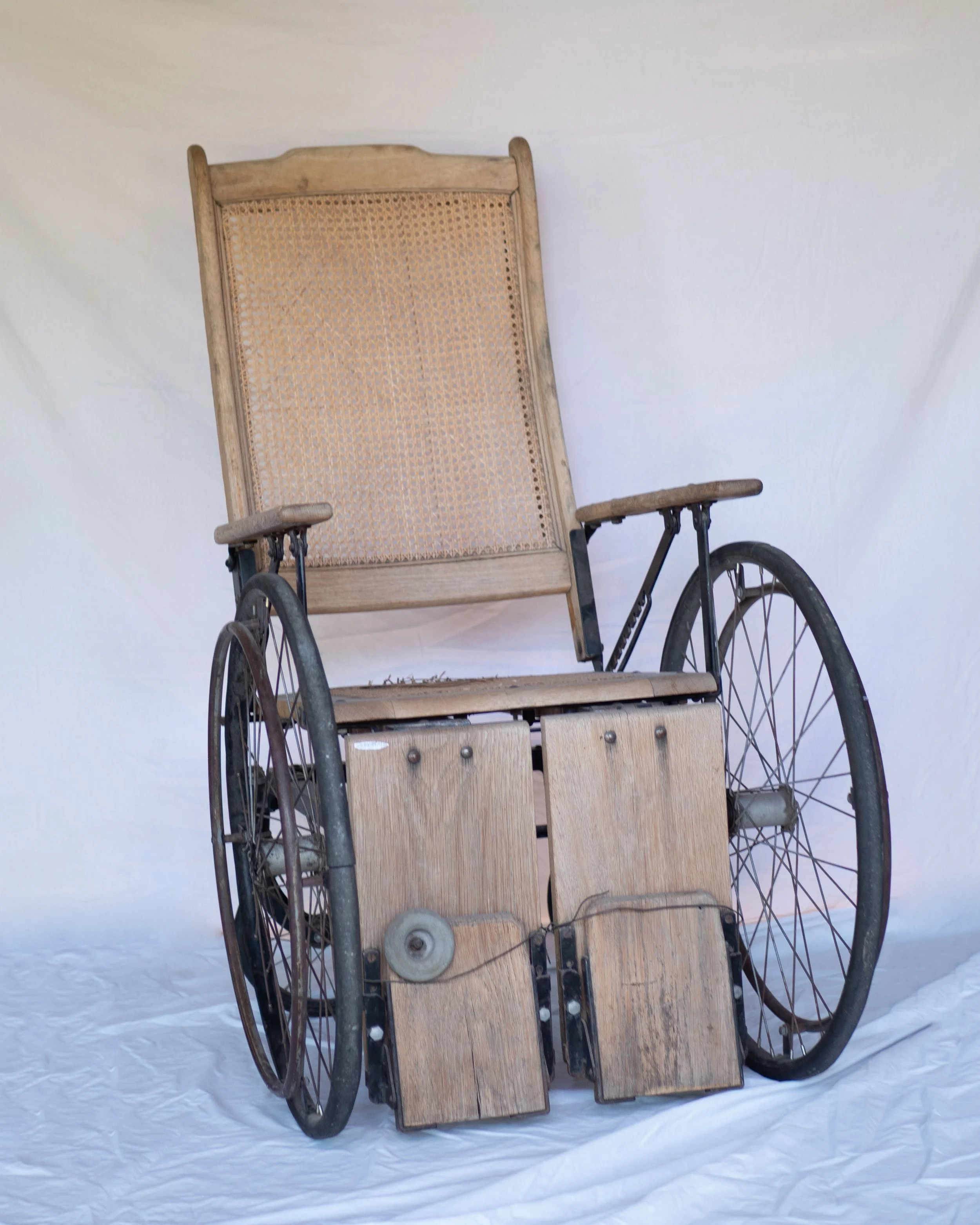
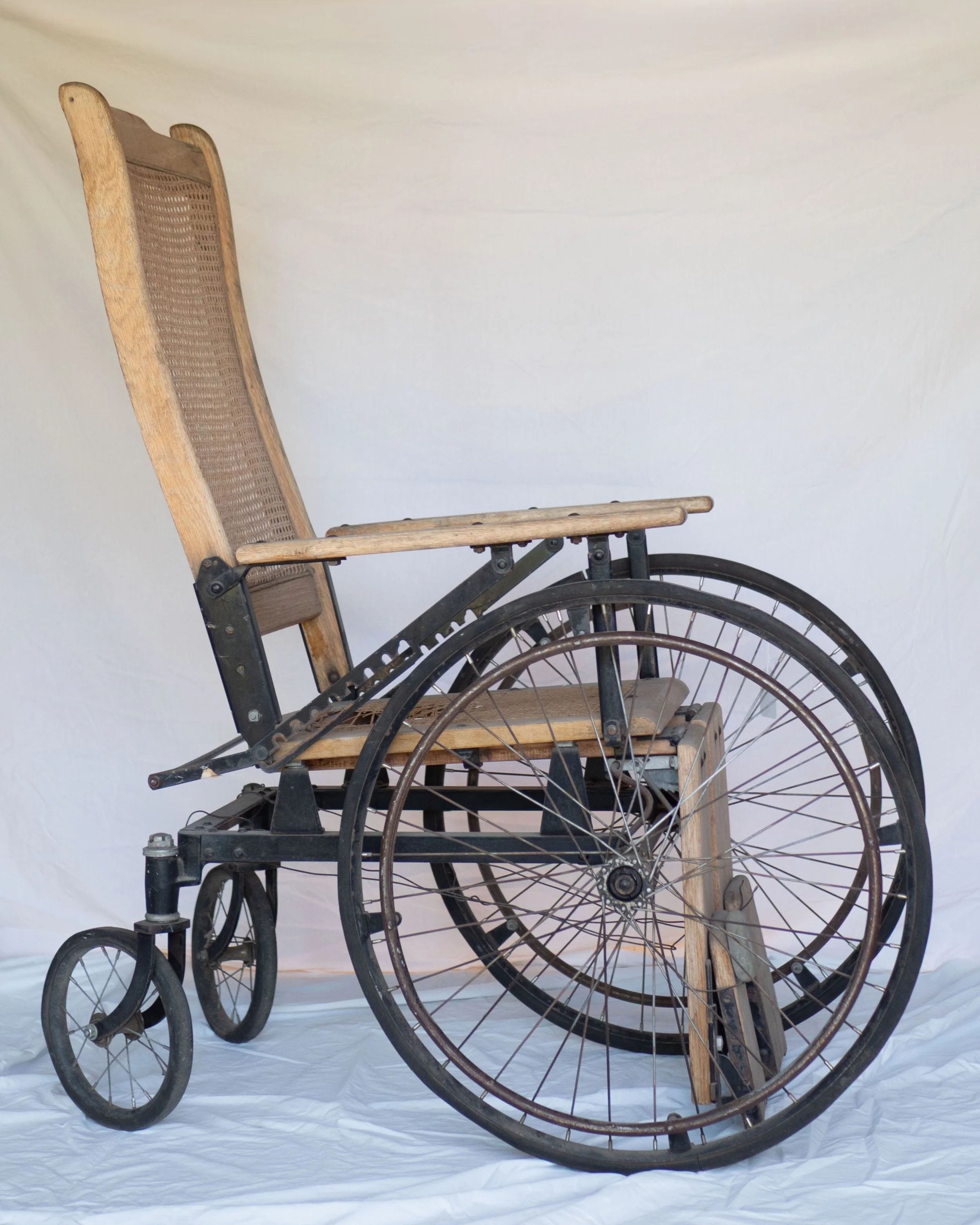
Compared to other wheelchairs in our collection, it’s somewhat lightweight. It has a wooden frame, but the seat and back are made of rattan (so whoever used it may have had some airflow!). It has no handles on the back, meaning it was likely only propelled by its user.
The chair features adjustable arm and leg rests for the user’s comfort — though the armrests’ lowest position is high enough to still make it difficult for someone using the chair to reach the grips on the wheels and propel themself. The back could also be adjusted into upright or more reclined positions, not unlike beach and pool chairs today.
Unfortunately, this sums up most of our information on this specific wheelchair. We aren’t sure when it was made or who used it. There are still plenty of questions to be asked about its history before coming to Fort Walla Walla Museum.
What can we find out about these wheelchairs? What about the people who used them?
This chair resembles wheelchairs (and “invalid chairs”) made and used in the late nineteenth and early twentieth centuries. Invalid chairs were forms of wheelchairs marketed toward caretakers and hospitals. They were meant to transport people who were ill, but they offered very little autonomy to those people. The goal was comfort, not mobility.
Our wheelchair look very much like these “invalid chairs.” It closely resembles an item for sale in a 1910s medical catalogue!
These chairs might also look familiar if you know a lot about presidential history. They appear somewhat similar to wheelchairs used by Franklin Delano Roosevelt shortly after polio left him paralyzed.
These chairs are quite heavy! They are hard to push, often too wide to fit through door frames, and difficult to maneuver through tight spaces and turns. People using these chairs might have to rely more on those around them to get around most spaces, including their own homes. It’s no wonder wheelchair users like FDR were known for tinkering their own, more mobile wheelchairs!
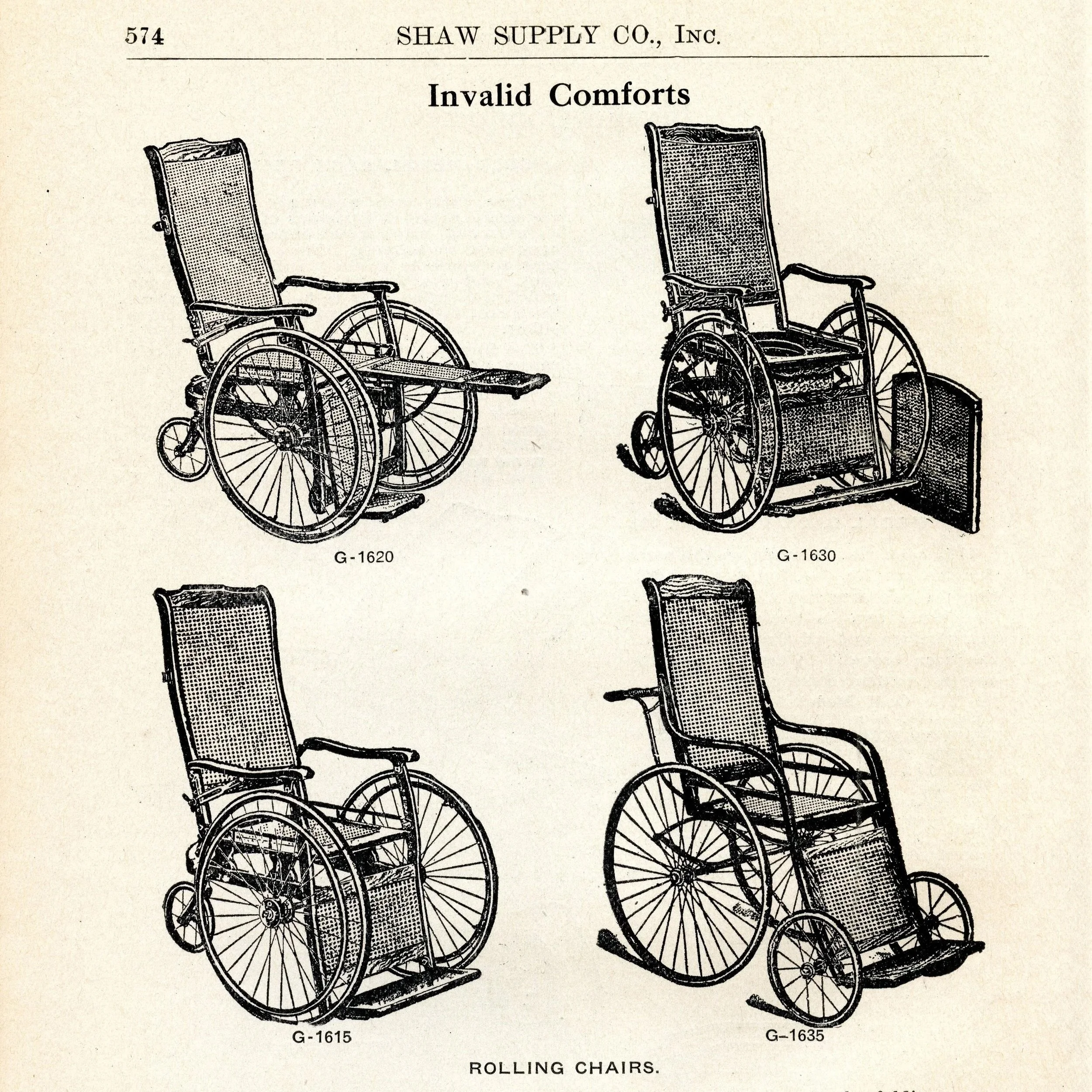
Photo courtesy of Shaw Surgical Supply Co. Surgical Catalogue, 2nd Edition, ca. 1910s
This antique style of wheelchair is no longer used today. Now, the focus of wheelchair manufacturers is not only comfort, but ease of use and functionality for wheelchair users. While this style of wheelchair — a strong but heavy wooden frame, a wide seat, adjustable arm and leg rests, push-rims on the wheels, and handles on the back — is a definite improvement on older models, it is certainly very restrictive.
In the 1930s, the first “modern” wheelchair was created by two mechanical engineers. Harry C. Jennings alongside Herbert Everest, who had been injured in a mining accident, designed what we now picture when we think of wheelchairs. Nowadays, wheelchairs are typically made of lightweight steel frames which can collapse in on themselves for easy storage and transportation. Their invention was ultimately used by FDR himself and even Winston Churchill!
There is still so much we can learn from artifacts like this wheelchair. They tell us about people who were often ignored by history: the sick, the injured, and the different. People, perhaps someone local to Walla Walla or the surrounding area, used this chair. They would have found greater access to the world through this mobility aid. Now it remains in Fort Walla Walla Museum’s collection as a reminder of diversity and difference in history.
