
A brief story of Dorsey “Doc” Syng Baker
The Man, Myth, and Locomotive Legend
Dr. D. S. Baker is a uniquely prominent figure in Walla Walla’s history. An early pioneer, his visions for the future were constantly pulling him towards more ambitious projects. He had a singular determination to make a name for himself. Through his own keenness in personal investments and his commitment to the betterment of Walla Walla, he has achieved a legacy like no other.
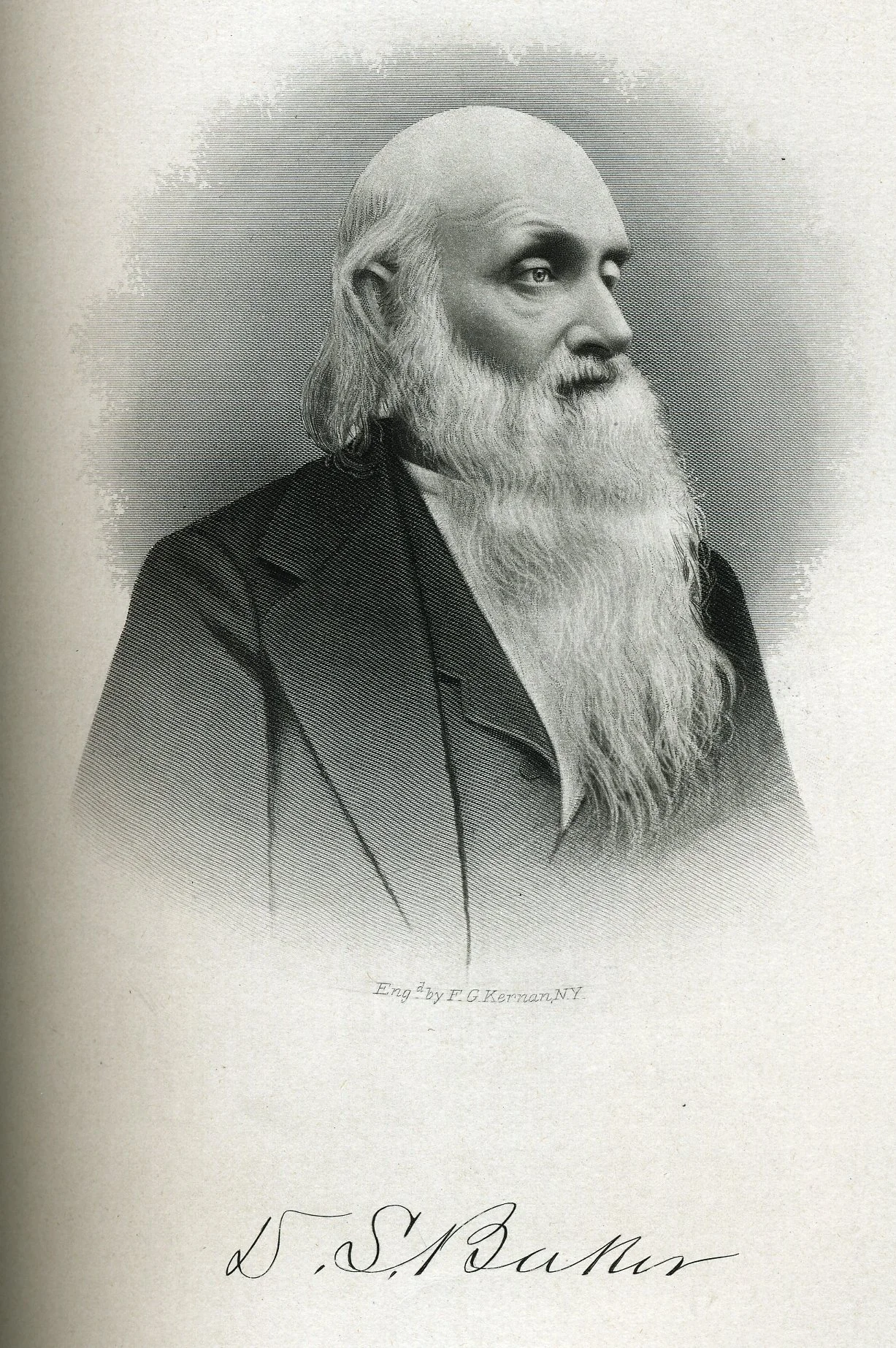
A portrait of Dr. Baker towards the end of his life, along with his signature.
Born October 13, 1823, Dr. Baker was one of the thousands who moved west in the 19th century, leaving his home state of Illinois to join a wagon train. He was poor and could not afford to bring much more than himself, save his skills and a mule. A recent graduate of the Jefferson Medical College in Philadelphia, he used his knowledge as a physician to provide medical services along the Oregon Trail in exchange for food and other supplies. While on his trip, he met the Wagon Train Master’s daughter and fell in love. The match was not to be, as her father knew of Baker’s meagre earnings and did not want his daughter to suffer being a pauper’s wife. Perhaps it was this early heartbreak that spurred the young man to pursue so many lucrative investments.
Baker’s journey West concluded when, in 1848, he reached Portland, Oregon. He started a family, using his physician’s training to begin his new life. Baker did well for himself, pursuing a variety of business ventures on his travels and at home. His father had been a farmer and merchant in Illinois, preparing Baker to succeed in all industries of the West. While his family lived in Portland, Baker continued to travel the West, going to the gold fields of northern California and settling the town of Oakland in Oregon. Then in 1860, inspired by the ongoing construction of the Mullan Road and Idaho’s gold rush, he moved to start a mercantile in the bustling metropolis known as Walla Walla.
In the year 1853, Baker’s sister Sarah Elizabeth married a man named John F. Boyer. This union brought together the minds of Baker and his now brother-in-law Boyer. Dr. Baker had already established his own mercantile and farming enterprises in Walla Walla, and upon Boyer’s arrival in 1862, the two men became business partners as well as family. Seven years later, when the Idaho gold rush had slowed to a trickle, Baker and Boyer decided to close their mercantile. They kept the storefront that had been their place of business and established a bank there, now referred to as “Baker Boyer National Bank.” The Doctor’s success in merchandising and banking having thus proved his business acumen, he moved on to his next visionary idea.
In 1871, the Doctor started a daring project. At this time in the Northwest, there existed only two small portage railroads. It was in this absence that Baker devised to build the first point-to-point railroad. Having gotten the right-of-way for the length of track needed, all that was to be done was to finance the project. This was no small feat, as an unfortunate experience with a local and highly respectable farmer soured public opinion against funding.
As an aside, the unfortunate experience is recorded in Forty Years A Pioneer as follows:
“The reason for the failure to carry the affirmative vote [ for a bond financing the railroad] at the election can rightfully be attributed to no greater nor less influence than that of a tiny insect commonly known as the bed bug… Dr. Baker was deeply interested in the success of this contest and made a personal house-to-house canvass in some of the rural districts of the county in the interest of carrying the necessary vote.
“A well-known and influential farmer…owned a stage station, country store, hotel and saloon—the latter a prerequisite to any successfully operated stage station. It was on one of these electioneering trips that Dr. Baker…accepted the hospitality of this man for the night. This was purportedly designed in order that his influence might be secured in favor of carrying the bond issue. But little argument was necessary to convince this man of the merit of the cause and he agreed to join the effort to carry the election. All went well until the dawn of the following day, when the host learned that a change to the hayloft had been made by his guests during the night in their sleeping quarters, due to the presence of insects in the room assigned to them. When told of this, the landlord became greatly incensed and declared that his house was not so infested, and thereafter he bent his efforts to defeat the carrying on the election in favor of the bond issue. This effort without doubt was the cause of its failure, inasmuch as ten more votes would have changed the results.”
(p. 166)
Fortunately, funding was eventually found, with Baker taking on the majority of responsibility. Slowly he secured the timber, laborers, and rails necessary to start the road in Wallula. Knowing that completing this railroad would require a frugal mind, Baker sought to save money wherever he could. He harvested his timber near Ellensburg and had it floated down the Yakima and Columbia rivers, building a mill where the wood was caught. He had his son supervise the mill, entrusting that the work would be done. By 1874, the line stretched 16 miles inland towards Touchet, and in 1875 the railroad was completed. This achievement settled a vision Baker had long nourished, to open the rich agricultural hub of the Inland Northwest to the world. It was this railroad that allowed Walla Walla to flourish and become the town we know today.
Dr. D. S. Baker’s ambition, boldness, and achievements have been reinvested into Walla Walla many times over. His early donations to schools in the valley and his commitment to providing a better life for himself and the town he lived in are all still present in Walla Walla’s spirit today. October 23rd marked the 150th anniversary of the Walla Walla & Columbia River Railroad’s completion. This is the time to acknowledge not only the regional and national importance of the WW&CR RR, but to honor Doctor Baker’s pioneering spirit.